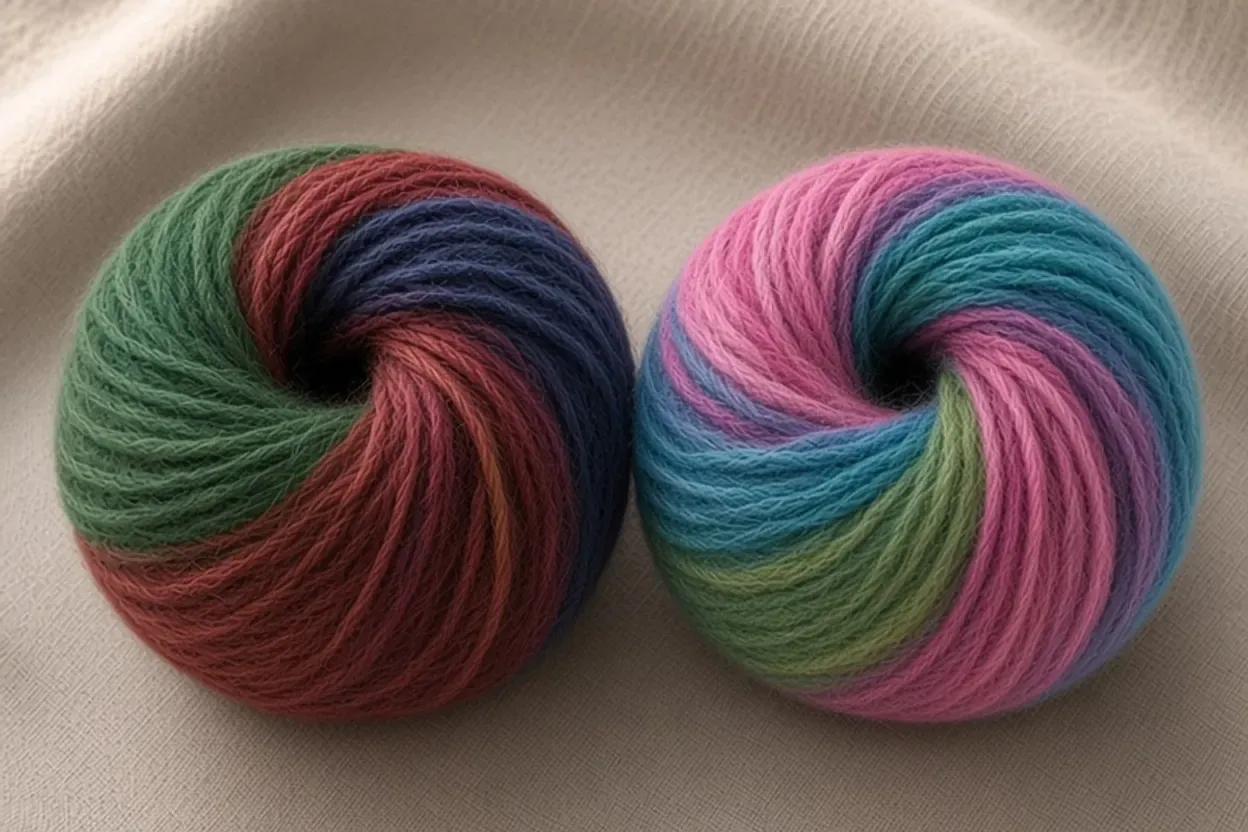
Side by side
| Silk Garden | Kureyon | |
|---|---|---|
| Fiber | 45% silk, 45% kid mohair, 10% lambswool | 100% wool |
| Ball | 50 g, 100 m (about 109 yd) | 50 g, 100 m (about 109 yd) |
| Weight | Worsted | Worsted |
| Gauge | 4½ sts per inch on US 7–8 | 4½ sts per inch on US 7–8 |
| Feel | Soft, with sheen and a light halo | Crisp, warm, a little rustic |
| Color | Long striping runs, blended at the edges | Long striping runs, clearly banded |
| Felts | Not the one to felt | Yes, it is a felting yarn |
| Care | Dry clean | Dry clean |
The short answer
Silk Garden for anything worn against the skin: a scarf, a cowl, a shawl, a hat. Kureyon for mittens, bags, anything felted, and outer layers where warmth and wear matter more than softness. If you are knitting a pattern written for either one, the other fits it stitch for stitch.
How they feel
Kureyon is wool and nothing else, lightly spun and slightly uneven. It has the dry, springy hand of a traditional wool and it softens with wear and washing. Some people find it scratchy at the neck.
Silk Garden is mostly silk and kid mohair with a tenth of lambswool to hold it together. The silk gives it weight, drape and a quiet sheen; the mohair gives it a faint halo. It is the softer of the two by a clear margin, and the fabric hangs rather than stands.

How the color reads
Both are dyed the same way: long lengths of fiber colored in sequence before spinning, so a ball moves through a planned run of shades over many yards.
The difference is in the edges. Kureyon's wool takes the dye flat and the stripes change over cleanly, so the bands are distinct. Silk Garden's halo softens each change, and the silk catches light differently from the mohair, so the same sequence looks blended. Choose Kureyon when you want the stripes to be the design, and Silk Garden when you want the color to shift.
In both, two balls of one colorway start at different points in the sequence. For a scarf that is part of the charm. For a sweater, knit from two balls alternately, or wind off to match the starting color.
Felting
Kureyon felts readily and evenly, and it is the classic Noro for a felted bag. The felted bag guide has the shrinkage to plan for.
Silk Garden is not the one to felt. Nine-tenths of it is silk and mohair, and it is the wrong yarn to put through a hot wash on purpose.

How many balls
Each ball is 100 meters, about 109 yards, in either yarn, so the counts are the same.
| Project | Yards | Balls |
|---|---|---|
| Adult hat | 130–180 | 2 |
| Scarf, 7 × 60" | 330–400 | 4 |
| Cowl, one loop | 190–240 | 2–3 |
| Mittens, pair | 150–200 | 2 |
| Adult sweater, 38–42" chest | 1,000–1,250 | 10–12 |
Add a ball for a sweater; Noro's dye lots differ more than most and a matching ball is hard to find later. The yarn calculator gives the count for other sizes. For a long scarf or a wrap with no joins, Noro Ito is Kureyon's wool in a 200 g cake of 437 yards.
Care
The ball bands on both say dry clean. If you hand wash anyway, use cool water, do not wring, and dry flat. Be gentlest with Kureyon: agitation and heat are exactly what felts it.
Substituting one for the other
Same ball, same length, same gauge, so the ball count carries over unchanged. What changes is the fabric: a Kureyon pattern knit in Silk Garden drapes more and holds its shape less, which suits a shawl and does not suit a structured bag. A Silk Garden pattern knit in Kureyon comes out firmer and warmer. For the rest of the family, the cakes, the tweed and the DK lines, see Noro: which one is which?
