Why it costs what it does
Cashmere is the downy undercoat a cashmere goat grows against a Mongolian or Himalayan winter, combed out once a year in spring. After the coarse guard hair is removed, one goat gives about four ounces of usable fiber. A sweater is three or four goats' worth of a year. The fiber itself is 14 to 19 microns across — merino is 18 to 24 — and it is short, which is why cashmere is so soft and also why it pills: short fibers work loose.
Price per gram is the honest test. A 100% cashmere skein that costs what a merino does is either not 100% or not a grade you want next to your skin.
100% cashmere, or a blend
100% cashmere is the warmest fiber for its weight, has a dry, soft hand with a slight halo, and drapes rather than springs. It has little memory, so ribbing relaxes and a fitted sweater grows. It pills in the first few wears and then settles. It is for scarves, cowls, hats, shawls, baby things and sweaters for people who will hand wash them.
Cashmere with merino is the sweater blend. Merino brings crimp and memory, so a cuff stays a cuff; 20% cashmere is enough to feel in the hand and at the neck, and 75% is close to the real thing with better behavior. The price drops with the percentage.
Cashmere with silk trades warmth for luster and drape. A silk-cashmere shawl shines and swings; a sweater in it is cool and heavy.
Cashmere with a little nylon lets a mill blow the fiber into a light chainette instead of spinning it, which is how Lang Cashmere Light gets a worsted gauge from 25 g skeins.
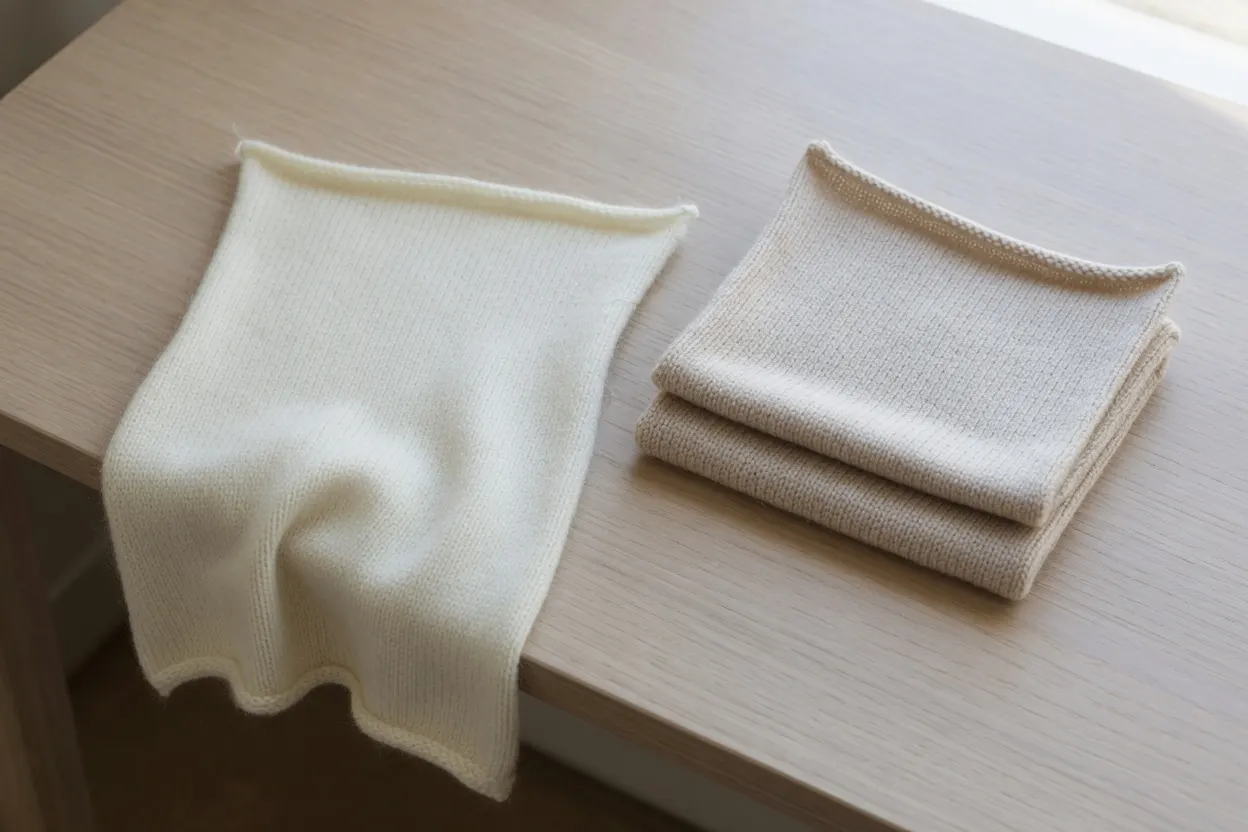
The cashmere yarns we stock
| Line | Content | Gauge | Yards / skein | Price | Colors |
|---|---|---|---|---|---|
| Artyarns Cashmere 1 | 100% cashmere | Lace, 8 sts/in | 510 yd / 50 g | $65.50 | 12 |
| Lang Cashmere Light | 88% cashmere, 12% nylon | Worsted, 20 sts/4" | 93 yd / 25 g | $38.50 | 3 |
| Juniper Moon Saxony | 75% cashmere, 25% merino | Worsted, 16–20 sts/4" | 120 yd / 50 g | $31 | 5 |
| Artyarns Ensemble Light | 50% silk, 50% cashmere | DK, 5 sts/in | 400 yd / 80 g | $73 | 12 |
| Artyarns Cashmere Eco | 50% recycled, 50% new cashmere | DK, 3–5 sts/in | 164 yd / 50 g | $43.50 | 5 |
| Artyarns Merino Cloud | 80% merino, 20% cashmere | DK, 5½ sts/in | 436 yd / 100 g | $43.50 | 13 |
| Malabrigo Caprino | 80% merino, 20% cashmere | DK, 24 sts/4" | 164 yd / 50 g | $19.25 | 12 |
| The Fibre Co Arranmore Light | 80% wool, 10% cashmere, 10% silk | DK tweed, 22–24 sts/4" | 328 yd / 100 g | $23.50 | 2 |
All of them are hand wash, cool, dry flat. The Artyarns lines are hand-dyed in small lots; buy the whole project at once.

What a sweater costs
For a plain 40" pullover — about 1,300 yards at DK, 1,100 at worsted, from the sweater yardage guide — rounded up and with the one spare skein you should always buy:
| Line | Skeins | Cost |
|---|---|---|
| Arranmore Light (10% cashmere) | 5 | $118 |
| Malabrigo Caprino (20%) | 9 | $173 |
| Artyarns Merino Cloud (20%) | 4 | $174 |
| Juniper Moon Saxony (75%) | 11 | $341 |
| Artyarns Ensemble Light (50%, with silk) | 5 | $365 |
| Artyarns Cashmere Eco (100%) | 9 | $392 |
| Artyarns Cashmere 1 held double (100%) | 7 | $459 |
| Lang Cashmere Light (88%) | 13 | $500 |
Caprino and Merino Cloud are the same sweater for the same money; Caprino is a round, plied yarn with Malabrigo's hand-dyed color, Merino Cloud a softer single with a halo. Saxony is the most cashmere you can put in a sweater that will still hold its shape. Cashmere 1 held double knits at a sport gauge and makes the lightest sweater on the list, and the one that most needs hand washing.
For smaller things the arithmetic is kinder. A scarf is two skeins of Caprino, $38.50. A hat is one skein of Saxony or two of Caprino. A lace shawl is one skein of Cashmere 1 — 510 yards — and that single $65 skein is the best-value 100% cashmere on the site. A cowl in Cashmere Light is two or three 25 g skeins.

What to knit in it
Things that touch skin and do not take wear: cowls, scarves, hats, shawls, the yoke and collar of a sweater, a baby blanket. Not socks, not mittens, not elbows — cashmere abrades. If a whole sweater is the plan, choose a merino blend or knit it a little firmer than the band's gauge, keep the body short, and give it seams.
A trick worth knowing: hold a strand of Cashmere 1 with a wool or mohair yarn. It adds the hand and the halo to the whole garment for the price of one skein of lace, and the holding yarns together guide has the gauges.
Pilling and care
Every cashmere pills at first. Wear it, let the loose fibers surface, and take them off with a sweater comb or a cashmere stone; after a few wears it stops. Do not pull pills.
Hand wash in cool water with a wool wash or baby shampoo, press the water out in a towel, dry flat and reshape. Never hang it wet. Store it clean, folded, in a sealed bag or box over summer: moths prefer cashmere to anything else in the house, and a sachet is a deterrent, not a wall.
Reading a label
"Cashmere blend" with no percentage usually means 5% or less, which is a word on a label rather than a fiber you can feel. "Cashmere-like," "cashmerino" and "cashmere soft" contain none. Look for the percentage, then the price per gram, then the yardage: a 100% cashmere at 500 yards to 50 g is a lace yarn however it is photographed, and a 25 g skein at worsted gauge has been blown, not spun. The luxury fibers guide explains what the rest of the price buys.


