Gauge calculator
Count the stitches and rows across a washed swatch and the calculator gives your gauge, says which way to change needles to match a pattern, and turns a width into a cast-on at the gauge you actually have.
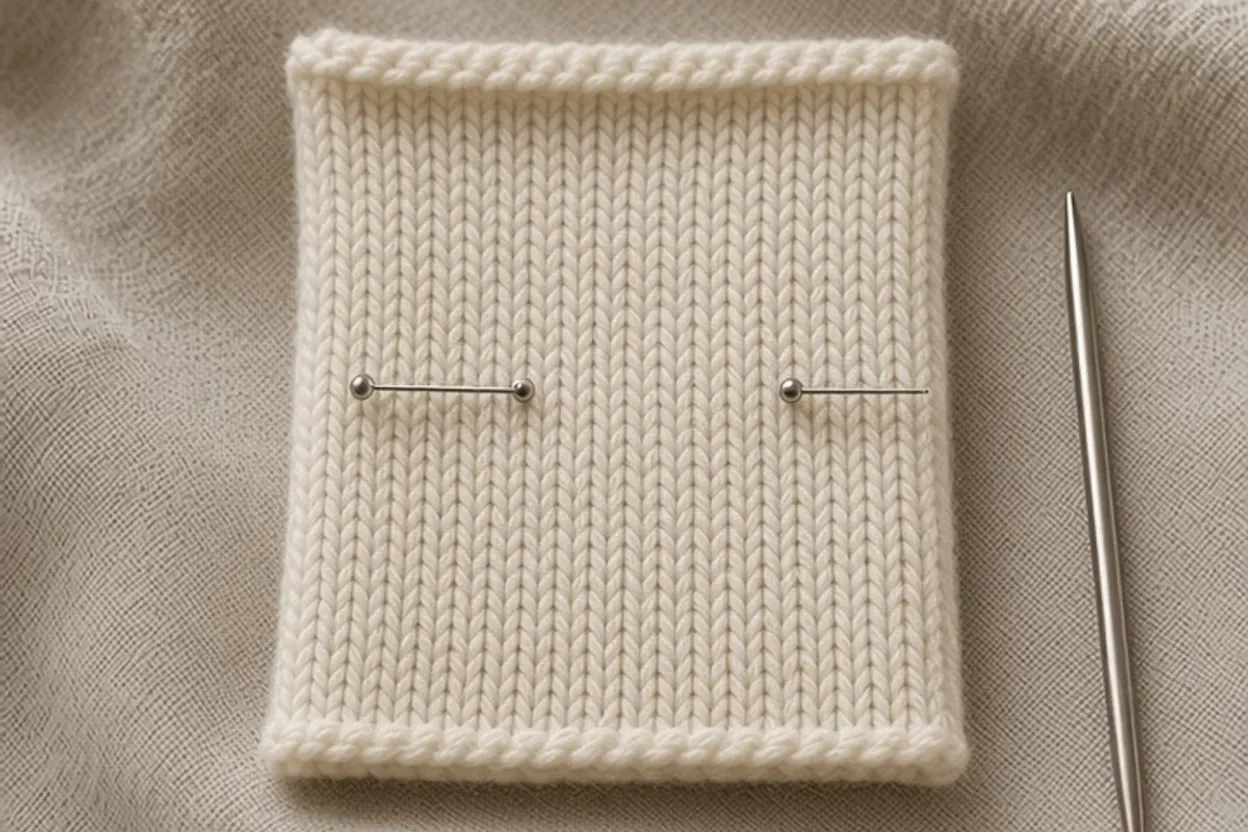
Measure the swatch honestly
Knit at least 6" square, wash and dry it the way the finished piece will be washed, lay it flat without stretching, and count across the middle 4" — including half stitches. The gauge swatch guide is the whole method, including swatching in the round for a project in the round.
How the needle suggestion is worked out
More stitches per 4" than the pattern means your fabric is tighter, so the needle goes up; fewer means down. One needle size moves the count by about one stitch per 4" at worsted weight and about two at fingering, where each size step is a smaller share of the stitch — the calculator scales by the pattern's gauge. Within half a stitch you are on gauge; a wash and a block absorb that. Change the needle, not your hands, and swatch again. The needle size chart has the steps in millimeters.
The yarn and needles beside the calculator
Once a gauge is typed, the column beside the calculator lists the yarns we have in stock in the weight that gauge belongs to, the ones whose own ball band names it first and best sellers first after that, with the needle sizes those yarns call for. A pattern gauge takes over from the swatch as soon as you type one, because that is the fabric the project needs.
Rows
A row gauge that is off while the stitch gauge is right is common and usually fine: most patterns give lengths in inches. It matters for a yoke or raglan shaped by row counts, where the stitch gauge wins and the rows are recalculated.
Cast-on for a width
Width in inches times your stitches per inch, rounded to the stitch pattern's multiple if it has one (a 4-stitch rib, a 6-stitch cable) plus any edge stitches. For a hat in the round, use the head circumference less an inch or two of negative ease; for a scarf, the width you want.
The guides behind the numbers
- GuideKnitting math: from a gauge swatch to a sweater that fitsThe three numbers that size a sweater — gauge, body measurement and ease — how to turn inches into a cast-on, what to do when your gauge is not the pattern's, how to pick a different pattern size to land on the chest you want, sleeve decrease spacing, and how yardage changes when gauge does.
- GuideHow to substitute yarn in a patternHow to pick a yarn a pattern was not written for — matching gauge, yards per gram, fibre and construction — with the arithmetic for recalculating the number of skeins.
- GuideThe gauge swatch: how to knit, measure and fix oneWhy every pattern says swatch, how big to knit one, how to wash and measure it honestly, what to do when the stitches or rows are off, what a swatch tells you besides gauge, and why a swatch in the round for a project in the round.
More tools
- Yardage estimator — How many yards a sweater, blanket, hat, scarf, cowl, mittens, socks, shawl or baby cardigan takes at each yarn weight, and how many skeins that is.
- Needle and hook size converter — US, millimeter and old UK knitting needle sizes, crochet hook letters and steel hook numbers, with a lookup that takes a size written any way.
- Yarn substitute finder — Describe the yarn a pattern calls for from its ball band and see the closest yarns we have in stock, with what to watch and the skeins to buy.
- Yarn held together calculator — What weight two or three strands held together knit like, the needle to start on, and the yarn in stock for each strand.
- One-skein project finder — Pick a hat, cowl, mitts, socks or shawl and see the yarns in stock where a single skein makes it.