What superwash means
Wool fibre is covered in microscopic scales. Heat, water and agitation make the scales on neighbouring fibres catch on each other and lock — which is felting, and which is why a wool sweater put through a hot wash comes out doll-sized. Superwash treatment either strips the scales with a chlorine process or coats them with a thin polymer, or both, so the fibres slide past each other instead of locking. The result can be machine washed cold on a gentle cycle without felting.
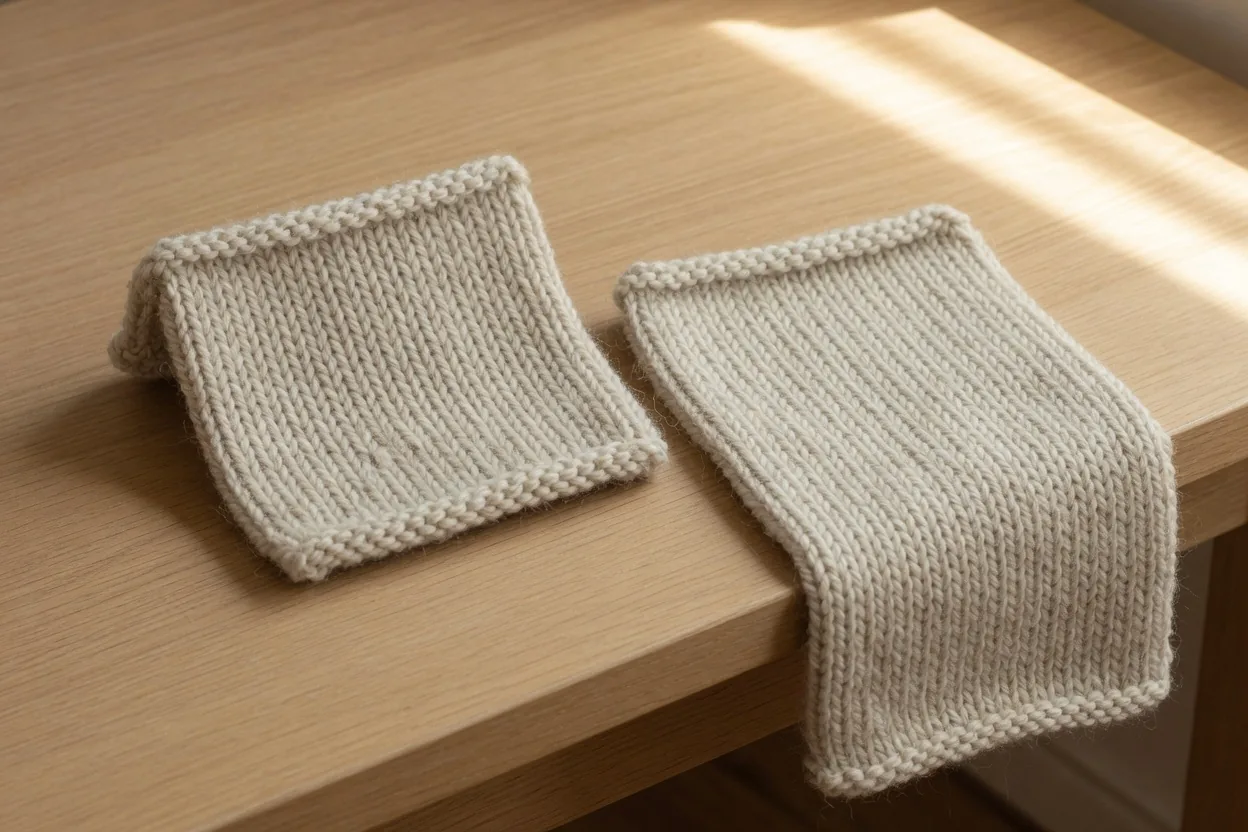
Non-superwash
The scales catch. Heat, water and agitation lock them.
Superwash
Stripped or coated, so the fibres slide past each other.
How it changes the yarn
Superwash wool takes dye more brilliantly, because the coated fibre reflects more light — the saturated hand-dyed colourways are almost all superwash. It is smoother and slightly heavier, and it drapes more; a superwash sweater hangs where a non-superwash one stands. It also has less memory: superwash garments grow in length with wear and washing, and are best dried flat, and ribbing loosens over time.
Non-superwash wool is bouncier and lighter for its thickness, holds its shape, blocks crisply and has the slightly matte, woolly look of a traditional sweater. It fulls gently with wear, which softens the fabric and closes up the stitches. It must be hand-washed in cool water and dried flat, and it will felt if it meets a washing machine.
When to choose which
Superwash for anything that will be machine washed: children's clothes, socks, everyday sweaters for people who do not hand-wash, blankets. Also for the deepest colours, and for garments where drape is the point.
Non-superwash for anything you want to felt, for colourwork — the fibres grip each other and even out the floats — for garments that must hold their shape (a fitted cardigan, a cabled pullover), and for the lightest, warmest fabric per gram. Also for anyone who prefers wool to be processed as little as possible.
Which is which on our shelves
Every yarn page shows a Superwash badge where the treatment applies, and the superwash merino listing collects them. Malabrigo is the clearest side-by-side: Rios is the superwash worsted and Malabrigo Worsted the untreated single-ply, in largely the same colourways. Anything on the felting page is non-superwash by definition.
Blends and cotton
Superwash refers only to wool. Cotton, linen, bamboo and acrylic have no scales and never felt; a wool-cotton blend felts only as far as its wool content lets it, which is usually not far. A blend with more than about 20% plant or synthetic fibre is effectively machine washable whether or not the wool in it was treated — but check the band, and swatch.

